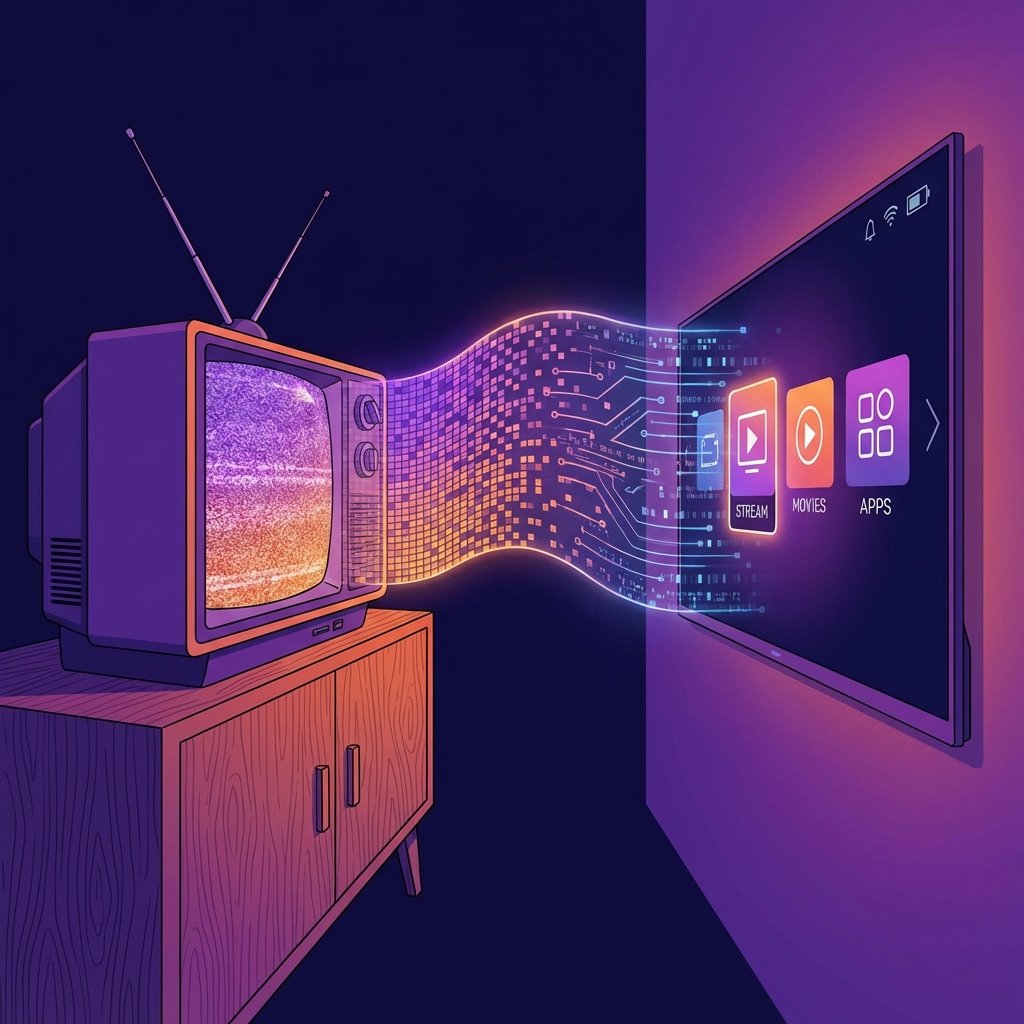
Television has undergone a radical transformation since its inception. From early analog broadcasts to today's 4K streaming, the journey of IPTV is fascinating.
The Beginnings: Analog Television (1950s-1990s)
The first televisions arrived in US households in the 1940s and 50s. The analog signal was transmitted over radio waves, and options were limited to a few national channels like ABC, NBC, and CBS.
- Limited image quality
- Dependence on physical antennas
- Few available channels
- No ability to record or pause
The Satellite and Cable Era (1990s-2000s)
HBO and other premium cable networks introduced the concept of premium television in the US. Satellite and cable offered more channels and better quality.
The Digital Revolution: DTV (2000s)
Digital Television became the standard in the US in the late 2000s, offering better image quality and more free channels. However, it was still a one-way street.
The Present: IPTV and Streaming (2010s-Today)
IPTV represents the latest evolution of television. It utilizes the Internet to deliver content, offering unprecedented advantages:
- Thousands of channels from all over the world
- 4K and HDR quality
- Catch-up TV to watch past shows
- VOD with movies and series
- Multi-device - watch on any screen
- Interactivity - pause, rewind, record
The Future of IPTV
The technology continues to evolve. Soon we will see:
- 8K Streaming
- Virtual reality and 360° videos
- Artificial intelligence for personalized recommendations
- Smart home integration
📊 Interesting Fact
It is estimated that by 2025, more than 70% of US households will use some form of IPTV or streaming as their primary source of television entertainment.
Technical Milestones in Television Broadcasting (1950–2026)
Over the past seven decades, television delivery has evolved from high-power analog radio frequency towers to low-latency global cloud Content Delivery Networks (CDNs). Each generation multiplied visual resolution while shifting control from network schedulers to the viewer:
| Era | Delivery Medium | Typical Resolution & Codec |
|---|---|---|
| 1950s–1980s | Over-the-Air Analog VHF/UHF | 480i NTSC / 576i PAL (Uncompressed Analog) |
| 1990s–2000s | Digital Coaxial Cable & Ku-Band Satellite | 480p SD / 720p / 1080i (MPEG-2) |
| 2010s | Early Broadband Streaming & First-Gen IPTV | 720p / 1080p Full HD (H.264 / AVC) |
| 2020s–2026 | Fiber Optic & Edge CDN IPTV Clusters | 4K UHD 60fps HDR (H.265 / HEVC & AV1) |
The Next Frontier: AV1 Compression & Edge Server Routing
Today's IPTV infrastructure leverages automated BGP anycast routing, multi-region edge caching, and hardware-accelerated HEVC/AV1 decoding chips built directly into modern Smart TVs and streaming sticks. This architecture delivers broadcast-grade stability and instant channel switching across continents.
Frequently Asked Questions
Why is modern IPTV more reliable than early internet TV streams from a decade ago?
Modern IPTV combines fiber-to-the-home broadband speeds, distributed edge CDN clusters, adaptive HLS segmenting, and efficient H.265/HEVC hardware decoding to eliminate the bottlenecks of early single-server streams.
Do older HDTVs still work with modern 2026 IPTV services?
Yes. Plugging an inexpensive Amazon Firestick or Android TV box into any older HDTV's HDMI port gives it modern dual-band Wi-Fi and hardware H.265 decoding.